
Luminous Renaissance ✨: The Art of Kintsugi Glass
Updated: Apr 1, 2025
Kintsugi applied to glass: But is it truly Kintsugi?

Applying Kintsugi to Glass Objects
Kintsugi, traditionally used for ceramics, can also be applied to restore glass objects, though it presents a unique technical challenge. This was the case with this lamp designed by Rodolfo Dordoni for Foscarini, which I restored for a client. The piece, featuring a blown glass lampshade and an aluminum base, had suffered an accident that shattered it into multiple fragments, making the repair particularly delicate.

Unlike ceramics, glass presents specific challenges when applying Kintsugi. Its transparency and ability to diffuse light can create internal shadows and unwanted reflections, especially on translucent, polished, or colored glass. When an object shatters into multiple fragments, it also becomes more difficult to perfectly realign the pieces without causing optical distortions.
In the case of this lamp, the process was not just about repairing a single crack, but carefully reassembling each fragment while preserving the harmony of the original design lines.
Kintsugi on Glass: Modern Restoration or True Kintsugi?
Technically, this approach is inspired by Kintsugi, but it departs from its traditional philosophy.
Kintsugi is based on the idea of celebrating the cracks by making them visible and precious, typically using urushi lacquer sprinkled with gold, silver, or other metallic powders. The goal is not to hide the repair, but to integrate it as an aesthetic and philosophical element.
However, the technique I describe here, using epoxy resins with a refractive index close to that of glass for an almost invisible repair, followed by the addition of gold leaf, is closer to modern restoration, with a decorative touch inspired by Kintsugi.
A Contemporary Interpretation of Kintsugi
One could argue that this is not traditional Kintsugi, but rather a contemporary interpretation adapted to glass, which preserves the aesthetic spirit while considering the material’s specificities.
If you wish to stay true to authentic Kintsugi, you must accept that the cracks remain visible and embrace the imperfections, including the shading effects, rather than trying to conceal them. 😊
The Art of Glass Kintsugi
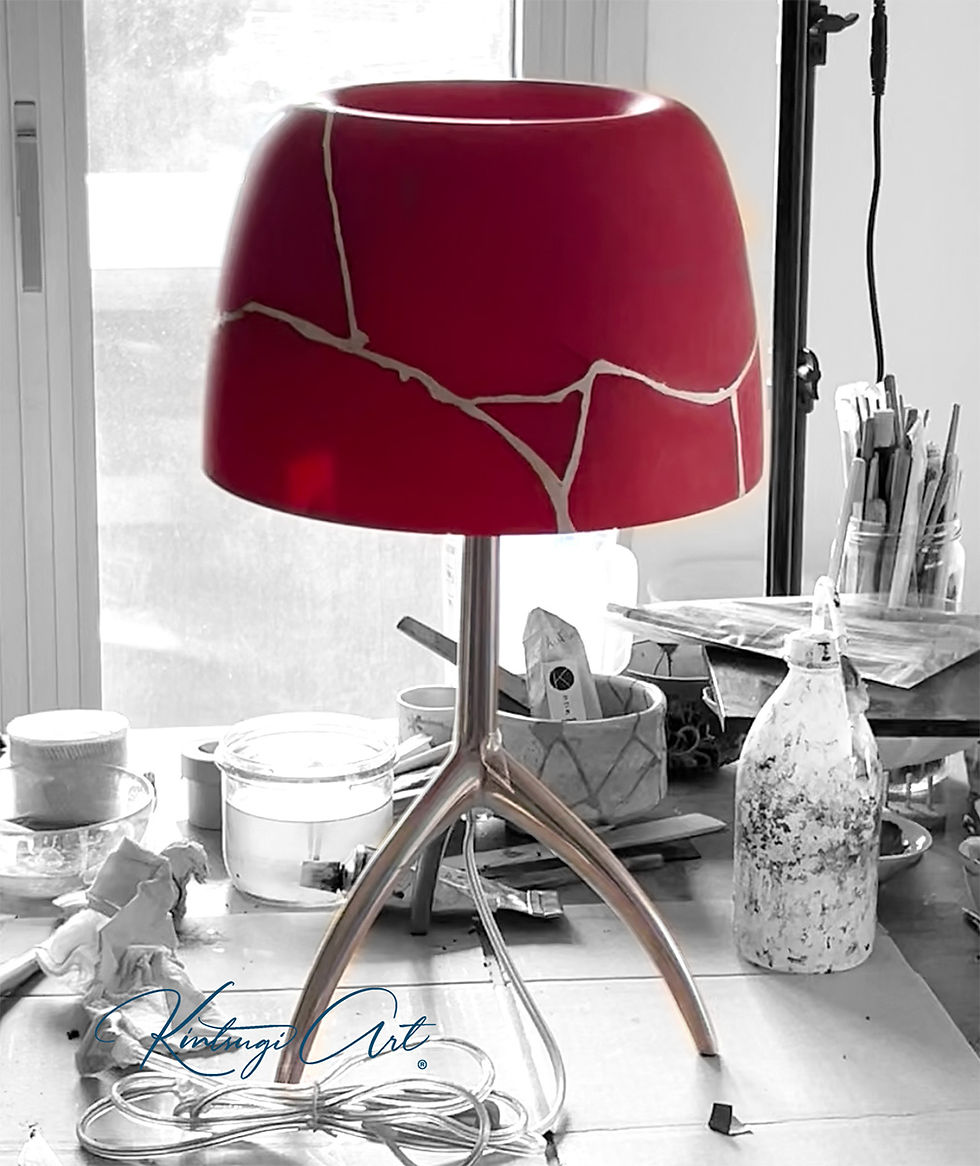
For this polished glass lamp, I used Jou Ki Urushi lacquer for glass, which is made up of 10% synthetic resin, unlike natural urushi.
This variant complies with Japanese food hygiene regulations.
I will now explain the step-by-step method I followed to perform Kintsugi on glass.

Important Reminder: Precautions when Using Ki Urushi Lacquer for Glass
When using Ki Urushi lacquer for glass, it is essential to take precautions, as the 10% synthetic resin it contains releases a strong odor.
To ensure your safety, it is crucial to wear protective clothing, gloves, sleeves, and a mask. Additionally, make sure to work in a well-ventilated area to minimize exposure to the fumes.
1. Assembling the Fragments

1. Gathering and Adjusting the Fragments
Preparing Kintsugi Repair on Glass: The Importance of Fragment Assembly
Just like with a traditional Kintsugi repair on ceramics, it is crucial to carefully gather and adjust the glass lamp fragments before starting the restoration process. This step helps to reassemble the original structure while ensuring safety and preventing cuts.
To guarantee an accurate final assembly, each fragment must be carefully numbered, avoiding any confusion during the reassembly process.
It is essential to follow this preparation phase properly, as it will make the application of Jouki Urushi lacquer for glass easier, ensuring a strong and harmonious repair.

Optimizing Fragment Adhesion Before Assembly
To ensure strong adhesion between the different parts of the glass lamp, it is essential to properly prepare the contact surfaces. Since the interior break surfaces are smooth, I start by roughening them with coarse sandpaper or a file to create a texture that promotes better grip during assembly.
Given that the reassembled lamp will have a certain weight, I have also chosen to use the “sute” technique to enhance stability. On each glass surface, I applied a thin layer of Ki Urushi lacquer mixed with a drop of turpentine using a brush, then allowed it to harden in the muro for 24 hours. This preliminary coating significantly improves adhesion between the fragments, ensuring a stronger and more durable bond during the final assembly.
Assembly and Construction of the Glass Lamp

Assembly and Construction of the Glass Lamp
Unlike Kintsugi on ceramics, Kintsugi on glass does not require an adhesive mixture such as Mugi Urushi or Nori Urushi. The procedure remains simple, but0 must be followed meticulously to ensure an optimal result.
Application of Jouki Urushi Lacquer for Glass
The application of Jouki Urushi lacquer on glass follows a precise process to ensure strong adhesion and a durable restoration.
1. Surface Preparation:
• Thoroughly clean the glass fragments.
• Lightly scratch the interior of the broken fragments using coarse sandpaper or a file to improve adhesion.
2. Lacquer Application:
• Using a fine brush, apply a very thin layer of Jouki Urushi lacquer for glass on the fractures, ensuring both sides of the fragments are covered.
• Allow the pieces to pre-dry in the muro for 45 minutes.
3. Adhesion Test:
• Before assembly, apply a test layer of lacquer on a glass plate.
• Check the adhesion of the lacquer by touching it with your finger. If it is still adhesive, you can proceed with the final assembly.

4. Assembly of the Fragments:
• Once the lacquer is ready, carefully position the fragments with precision and apply slight pressure to ensure a secure bond. Fix them in place using small pieces of adhesive tape.
• Allow to dry in the muro under optimal conditions for ONE MONTH to achieve a strong fixation.
Filling Gaps with Sabi
Unlike porcelain or stoneware, glass fractures are clean but often accompanied by tiny surface chips that are difficult to fill.
To achieve optimal filling, Sabi must be applied in multiple successive layers.

From This Stage Onward, We Follow Traditional Kintsugi Steps
As with any piece restored using the Kintsugi technique, the filling stage is essential for reconstructing missing parts and ensuring a harmonious finish.
1. Preparation of Sabi
• Sabi is a traditional mixture used to fill cracks and missing areas in Kintsugi.
• It consists of tonoko (or jinoko) earth mixed with Ki Urushi lacquer and a small amount of water to create a homogeneous paste.
2. Application to the Areas to Be Filled
• Using a toothpick or a wooden spatula, apply the Sabi to the missing parts of the piece.
• Smooth carefully to achieve an even surface.
3. Drying and Hardening
• Allow to dry in the muro for at least 24 hours to ensure the Sabi hardens properly.
• Once dry, gently sand (without scratching) to refine the texture and achieve a smooth surface, free of holes or scratches.
Continuation of the Kintsugi Process: Kuro Roiro Lacquer, Drying, Sanding, eUrushi lacquer (bengara), and Silver Powder

Refining and Enhancing the Fracture Lines
After filling with Sabi and allowing it to harden, we proceed with the following steps to refine the repair and enhance the fracture lines.
1. Application of Kuro Roiro Lacquer
• Several very thin layers of Kuro Roiro lacquer are applied to the filled areas to even out the surface and enhance adhesion for the following layers.
• The piece is then placed in the muro for optimal drying for at least 24 hours, or longer if necessary.
2. Sanding and Smoothing
• Once the Kuro Roiro lacquer is fully dry, a delicate sanding is performed with ultra-fine sandpaper (#800 to #2000) to achieve a perfectly smooth and even surface.
• This step is crucial to eliminate any irregularities and ensure a flawless finish. If necessary, perform a Sabi retouch, then resume the Kuro Roiro lacquer application before proceeding.
3. Application of eUrushi Lacquer
• A thin layer of eUrushi lacquer is applied to prepare the surface for the silver powder application.

4. Finishing with Silver Powder
• Once the eUrushi lacquer (bengara) is slightly tacky, the silver powder is gently sprinkled using a kebo brush or a Mawata silk ball.
• Any excess powder is carefully removed, and the piece is left to dry in the muro for several days to ensure perfect adhesion.
At the end of these steps, the repair is not only strong but also enhances the fracture, revealing the brilliance of the silver, in the spirit of traditional Kintsugi.


https://f8bet.luxury/ giúp tôi xem xét cách giao diện thể hiện trạng thái sau mỗi thao tác. Tôi quan sát sự thay đổi của nội dung, dấu hiệu nhận biết mục đang chọn và vị trí hiển thị thông báo. Khi kiểm tra Đá gà, Nổ hũ và Game bài F8bet, tôi chú ý đến việc các thành phần tương tác có được trình bày theo một quy tắc chung hay không. Phản hồi trực quan rõ ràng giúp người dùng hiểu thao tác đã được ghi nhận, đồng thời hạn chế tình trạng nhấn lặp lại do thiếu thông tin. Tôi cũng quan tâm đến cách diễn đạt trong thông báo, bởi câu chữ ngắn gọn và cụ thể giúp người…
Hi88 được tôi quan sát từ góc độ khả năng nhận biết và xử lý những thay đổi trong quá trình sử dụng. Tôi chú ý các thông báo khi trang tải chậm, danh mục chưa hiển thị đầy đủ hoặc một thao tác cần được thực hiện lại. Thay vì chỉ quan tâm việc trang có mở được hay không, tôi xem nội dung thông báo có giúp người dùng hiểu tình trạng hiện tại và biết bước tiếp theo hay không. Điều này cũng quan trọng khi chuyển qua lại giữa thể thao, casino trực tiếp và thư viện trò chơi, bởi người dùng cần phân biệt lỗi tải nội dung với việc chọn nhầm danh mục. Tôi đồng…
qq88 khiến mình muốn tìm hiểu sâu hơn những yếu tố tạo nên sự liền mạch trong quá trình sử dụng. Mình thường quan sát cách các danh mục được sắp xếp và vị trí những thành phần quan trọng trên trang chính. Khi tìm hiểu Thể thao với bóng đá, mình chú ý đến cách thông tin trận đấu và các lựa chọn kèo được phân chia. Sau đó, mình chuyển sang Casino để quan sát phần bàn chơi trực tiếp rồi tiếp tục với Nổ hũ. Mình muốn đối chiếu cách mỗi khu vực thể hiện nội dung riêng mà vẫn duy trì cấu trúc điều hướng chung. Việc tìm lại danh mục đầu tiên sau vài lần chuyển…
cm88 khiến tôi chú ý đến cách sắp xếp các thành phần ngay trên trang chủ, đặc biệt là sự phân biệt giữa nội dung chính và những chức năng bổ trợ. Tôi thử chuyển qua casino, thể thao và xổ số để xem tiêu đề cùng cách trình bày có giúp nhận diện từng khu vực nhanh chóng hay không. Sau đó, tôi quay lại trang đầu để kiểm tra khả năng định hướng khi chuyển đổi nhiều lần. Theo quan sát của tôi, bố cục có thứ tự rõ ràng giúp người dùng dễ ghi nhớ vị trí danh mục hơn. Tôi cũng quan tâm đến cách các thông tin được phân cấp, bởi việc đưa quá nhiều chi tiết…
đăng ký ex88 khiến mình chú ý đến cách những bước đầu tiên ảnh hưởng đến thói quen sử dụng về sau. Mình thường tìm hiểu trình tự tạo tài khoản trên máy tính rồi thử quan sát cách các mục tương ứng được thể hiện trên Mobile App. Khi tiếp tục khám phá, mình dành thời gian với Thể thao qua sảnh UG trước khi chuyển sang Nổ hũ để tìm hiểu Đường mạt chược của PG Soft. Việc sử dụng xen kẽ hai thiết bị giúp mình nhận ra những khác biệt trong cách quan sát từng phần. Qua nhiều lần tìm hiểu, mình dần hình thành cách tiếp cận phù hợp với từng màn hình và ghi nhớ…