
SABI / KOKUSO : The Art of Filling and Repair.
Updated: Apr 17
Updated on April 15, 2026
The Art of Filling
Too often overlooked or poorly applied, this stage remains essential in the practice of Kintsugi.
Indispensable to the final aesthetic of the piece, it is a crucial, patient process that can be repeated as many times as necessary to achieve perfection. In Kintsugi, we generally celebrate the brilliance of gold—that light which highlights the fracture and reveals the beauty born from the wound.
But before the gold comes the time of filling.
This is where Sabi Urushi comes into its own: a discreet yet vital preparation. Whether dealing with a simple crack or a deep loss of material, form must be restored to what has been broken before the shine can appear.
Sabi Urushi fills small surface imperfections; it smooths, refines, and prepares the crack to receive the metallic powder or colored lacquer.
Kokuso Urushi, for its part, rebuilds and restores volume to missing areas, sometimes even reshaping the material itself.
Sabi / Kokuso Urushi: The Art of Earths and Mixtures in Japanese Lacquer
In the practice of kintsugi, mixtures made from natural earths play an essential role. Derived from Japanese rocks and clays, these powders form both the structural foundation and the protective skin of the restored object. They are used to rebuild, smooth, and strengthen the piece before the application of the final layers of lacquer and gold powder. It is here that the unique aesthetic of your kintsugi takes shape.
Among these sabi urushi mixtures, four materials are essential and are used in a specific sequence: Wata (or Kokuso-wata), Kokuso, Jinoko, and then Tonoko.
Each has its own texture, function, and working rhythm.
Wata (or Kokuso-wata) — used to fill and reinforce deep cracks or significant losses; it forms the foundation of the repair.
Kokuso — used to sculpt and rebuild missing areas after the initial consolidation.
Jinoko — used to refine the repaired surface; it is a finer mixture applied as an intermediate layer before finishing.
Tonoko — used to smooth and even out the surface before applying the final lacquer and gold powder.

Reconstruction of a Missing Section of a Raku Bowl
Choosing Your Sabi or Kokuso in Kintsugi?
Of course, it will be up to you to assess the losses, breaks, chips, and cracks in each of your pieces in order to determine the most suitable base.
What question should you ask yourself? Is it just a small loss, a hole, or a large missing section? This will help you choose the right method (kokuso, filling, sabi). Take the time to analyze your piece carefully.
Small loss / minor chip: chipped rim, small crack, scratch, shallow indentation the overall shape remains intact.
→ Objective: smooth and fill delicately.
Hole / medium loss: visible cavity, but the piece remains stable and its silhouette intact; small cavity (1–2 mm).
Small missing section: chip, small fragment missing.
→ Objective: fill and restore a solid surface.
Large missing section: a fragment absent that alters the shape—such as a corner, a rim, a handle, or an entire section—depending on its size.
→ Objective: rebuild the volume and, if necessary, reinforce it.
Large areas that need to be rebuilt or filled will first be treated with kokuso, which provides strength and structural support to the repair.
Once this layer is fully dry and sanded, you will then apply sabi as needed to smooth and even out the surface, preparing the piece for the subsequent layers of lacquer.
A small reminder: a single filling (sabi) is not enough.
Depending on the depth or nature of the cracks, it is often necessary to apply several successive layers of kokuso, allowing each one to dry and be lightly sanded in between to ensure proper adhesion and prevent shrinkage.
Once the structure is stable and even, you can proceed with the application of sabi, also in several thin layers, until a perfectly smooth surface is achieved free of any defects, holes, scratches, or bumps ready to receive the finishing lacquer layers or gilding.
Summary Table for Choosing Sabi / Kokuso
Type of Repair | Recommended Mixture | Main Objective |
Small crack, scratch | Sabi Ki urushi + tonoko | Smoothing, sanding, and finishing before gilding |
Small cavity (1–2 mm) | Thicker sabi (ki urushi + jinoko), followed by tonoko | Filling before sanding |
Loss of material (chip, small missing fragment) | Kokuso (urushi + jinoko + sawdust / wood powder) | Solid structure, filling |
Reconstruction of form (handle, spout, rim, significant volume) | Kokuso-wata (urushi + plant fibers such as hemp | Strength, elasticity, lightness |

kokuso- kokuso-wata
Kokuso-wata refers to fibers (most often hemp) mixed with ki urushi lacquer, wood powder (keyaki/mokufun), and/or jinoko to create a stronger kokuso (the filling compound). Its role is to reinforce the paste and increase its mechanical strength in deep or extensive fillings.
Some practitioners choose carded silk (mawata) instead of hemp a fine and noble fiber in order to preserve the purity of the gesture and the subtle cohesion of the kokuso-wata mixture.
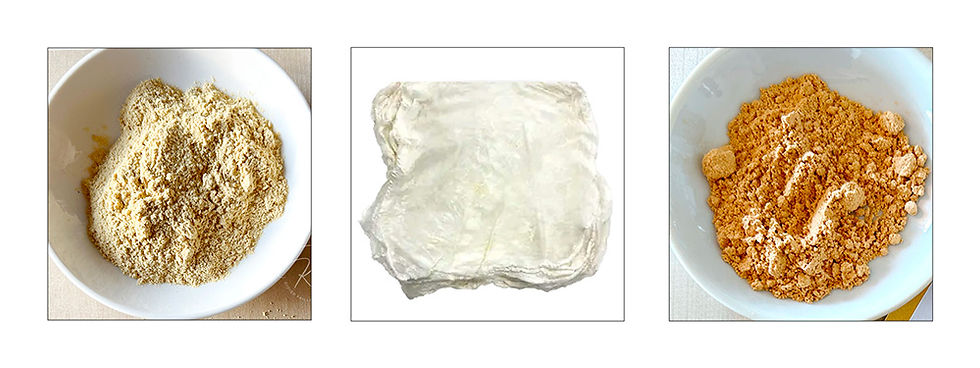
The proportions of kokuso are essential to obtain a paste that is strong, flexible, and durable in kintsugi repair.
Traditional Kokuso (with wood powder and fibers)
Basic ingredients: Urushi (natural lacquer), wood powder (mokufun or keyaki), plant fibers (wata).
Proportions: 1 part ki urushi to 3–4 parts wood powder, with 5–10% fibers.
Texture: A firm yet malleable mixture, adhesive without running. Adjust with urushi (if too dry) or wood powder (if too sticky).
Lighter Kokuso (Surface Use)
Proportions: 1 part ki urushi to 2 parts wood powder, without fibers.
Used for fine fillings or finishing work before applying sabi urushi.
Types of Powders and Their Effects
Keyaki: Zelkova wood powder, strong and firm.
Mokufun: Fine wood powder, with a smooth and homogeneous texture.
Wata: Plant fibers that reinforce cohesion.
Practical Example of Kokuso
(Adjust the quantities according to your needs.)
For a small repair:
1 teaspoon of ki-urushi,
3 to 4 teaspoons of wood powder (keyaki or mokufun),
a small pinch of wata fibers.
Adjust the proportions depending on the size and nature of the repair.
According to other traditional kintsugi schools, sabi kokuso is prepared by mixing 3 parts tonoko and 1 part jinoko, lightly moistened with a few drops of water, then bound with 2 parts ki-urushi and reinforced with a small amount of wata.
For the example of the Seto tea bowl (photo), where a large portion was missing, the reconstruction was carried out in thin layers in order to facilitate drying:
First layer: Kokuso + wata
(framework and base volume)
Second and third layers: Sabi jinoko
Fourth and fifth layers: Sabi tonoko
(refining and final smoothing of the form, until all holes, bumps, and depressions are completely eliminated. This stage must be perfectly completed before applying kuro-roiro lacquer, even if it means repeating several layers until an impeccable surface is achieved.)
4. Pay particular attention to the curing time: each layer must be completely dry and firm to the touch before any further work is undertaken.
5. A great deal of patience.
The Author’s Practical Tips
Intermediate Step: Optimizing Layering
After and sometimes between—several applications of sabi tonoko, I apply a very thin layer of kuro-roiro lacquer.
This layer is then left to polymerize in the muro (or furo) before being wet-sanded with fine-grit #800 sandpaper and water.
This intermediate phase aims to densify the structure of the filling, improve cohesion between successive layers, and increase the overall mechanical strength. It also promotes a more homogeneous surface for the finishing stages.
Always work in thin, gradual applications.
The thicker the layer, the longer the drying time in the murō/furō must be extended.

Kintsugi Process Logic (Technical and Traditional Approach)
Kintsugi is based on a precise layering of urushi, where each stage serves a specific function: structure, adjustment, and then finishing.
Jinoko: Natural Mineral Powder for Kintsugi
Construction and structural strength of the repair
Fills significant losses
Ensures mechanical strength
Serves as the base for the entire layering process
Jinoko earth from Yamashina comes from the Yamashina region, east of Kyoto, known for centuries for its natural deposits of volcanic clay.
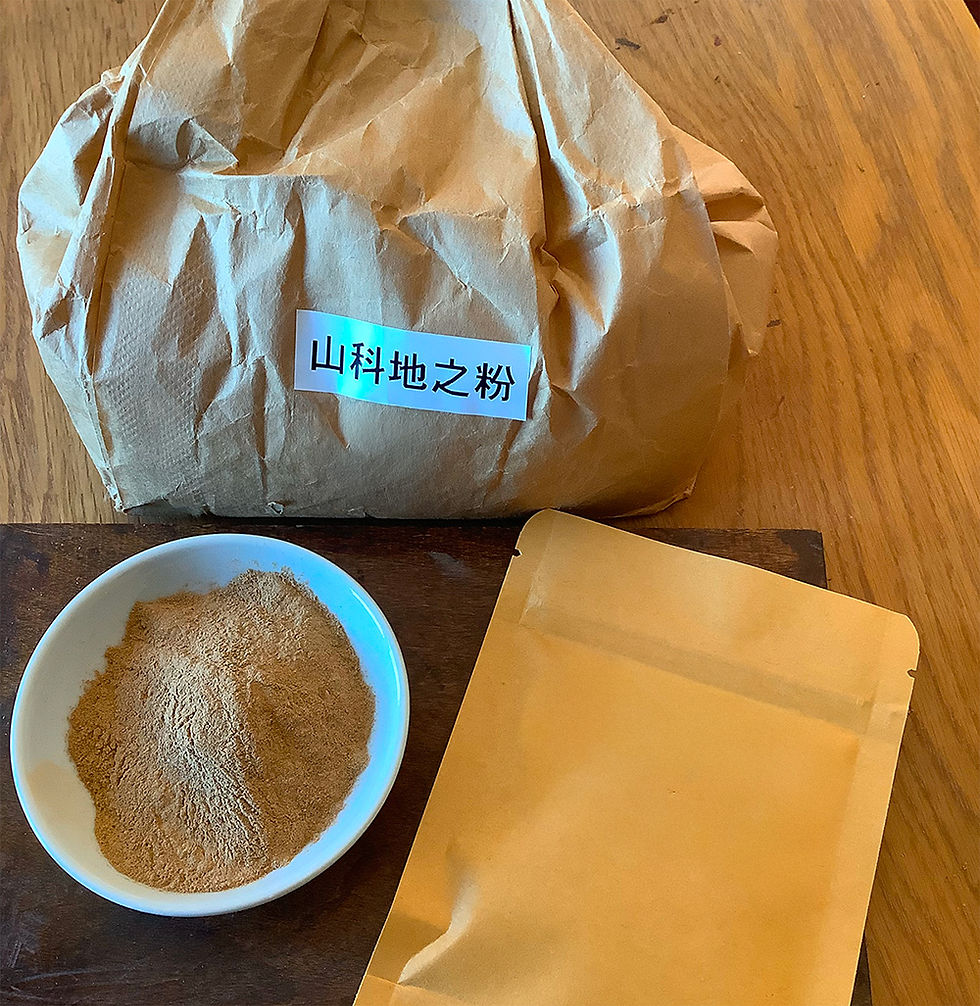
Rich in silica, alumina, and iron oxides, this highly pure earth displays an ochre to light red color and offers excellent compatibility with urushi lacquer. After extraction, it is dried, fired at high temperature, then ground and sieved to obtain a matte mineral powder, slightly porous and granular like sand.
Used in kintsugi as a base in the preparation of sabi, Yamashina Jinoko earth allows for the creation of strong, stable, and durable sabi mixtures. It ensures perfect adhesion and high resistance without cracking, making it the traditional reference material for Kyoto artisans in the practice of kintsugi.
This preparation forms the intermediate layer in kintsugi work, applied after the kokuso (reconstruction paste). It is often used in tandem with tonoko before the finer layers of sabi tonoko.
Traditional Proportions
1 part ki urushi
1.5 to 3 parts jinoko
A few drops of water
Note: Jinoko earth retains less water, much like sand. As a result, achieving proper cohesion in the mixture can be more challenging.
Desired texture:
A thick, malleable paste that holds on the spatula without running.
Tonoko in Kintsugi: Complete Guide (Yellow, Red, White, Uses and Techniques)
Adjustment
Tonoko is an essential clay powder in the practice of kintsugi and urushi lacquer. Used to create sabi-urushi, it allows you to smooth, adjust, and prepare repairs before finishing.
This comprehensive chapter explains:
the differences between yellow, red, and white tonoko
their mineral composition
their specific role in each stage of kintsugi
how to choose the right tonoko depending on your repair
What is Tonoko in Kintsugi?
Tonoko is a mineral powder composed mainly of silica and alumina, derived from natural clays. When mixed with urushi, it forms a paste used to refine repairs. It is applied after the structural stages and before the finishing phase.
The Different Colors of Tonoko

Yellow Tonoko: The Versatile Standard

Yellow Tonoko is the most widely used variety in Kintsugi. Its mineral composition, dominated by silica (SiO2) and alumina (Al2O3), also contains a small proportion of iron oxides, which give it its distinctive yellow hue. It also includes traces of natural clays such as kaolinite.
This composition provides an optimal balance between hardness and plasticity, as well as excellent compatibility with Urushi lacquer.
Thanks to its medium grain size and strong adhesion, yellow Tonoko is particularly well-suited for preparing Sabi-urushi.
t is used for fine filling, shaping, and the initial leveling layers.
Red Tonoko: Density and Tonal Influence
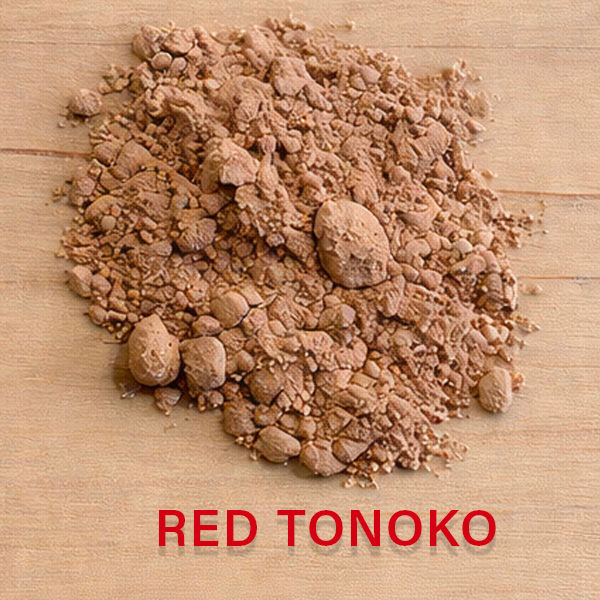
Red Tonoko is distinguished by a composition richer in iron oxides (Fe2O3), which gives it its warm color, ranging from deep red to brown. This higher iron content also results in a denser texture, which can sometimes be slightly harder to work with.
Thanks to these characteristics, it is primarily used in the intermediate layers, where it allows for the adjustment of the undercoat and the preparation of the surface before applying dark or colored finishes.
Red Tonoko thus plays a subtle but strategic role: it influences the final visual perception by subtly modifying the base upon which the Urushi layers and metallic powders are applied.
It is particularly valuable when the background color contributes to the final aesthetic result.
White Tonoko: Finesse and Precision

White Tonoko is the finest and purest of all Tonoko varieties. Its composition, which is very low in impurities and iron oxides, gives it a neutral color and a particularly smooth texture after sanding.
Thanks to its extra-fine grain size, it is used for delicate finishes where precision and surface quality are essential. In particular, it prevents "muddying" light tones or dulling the brilliance of gilding.
White Tonoko is therefore preferred for the preparation steps before applying gold or silver powder, as well as for work on light-colored or fine ceramics.
It is the ideal choice for achieving a clean, crisp, and perfectly controlled finish.
Simple Comparison
Feature | Tonoko | Jinoko |
Grain | Fine | Coarse |
Role | Finishing / Refining | Structure / Foundation |
Strength | Medium | High |
Sanding | Easy | More difficult |
Usage | Sabi-urushi, fine layers | Base layers, large gaps |
Kintsugi Process Logic
Structure — Jinoko + Urushi + Kokuso
→ Construction and mechanical strength of the repair.
Refinement — Tonoko + Urushi (Sabi-urushi)
→ Shaping, volume correction, and smoothing.
Intermediate Layer — Urushi (Kuro-roiro)
→ Leveling, surface preparation, and base for the final finish.
Finishing — Urushi (E-bengara) + Metallic Powder
→ Application of final lacquer followed by powder dusting (gold, silver, brass, etc.).
In summary:Jinoko = StructureTonoko = Precision

© Original content — all rights reserved. Unauthorized reproduction is prohibited.


Comments